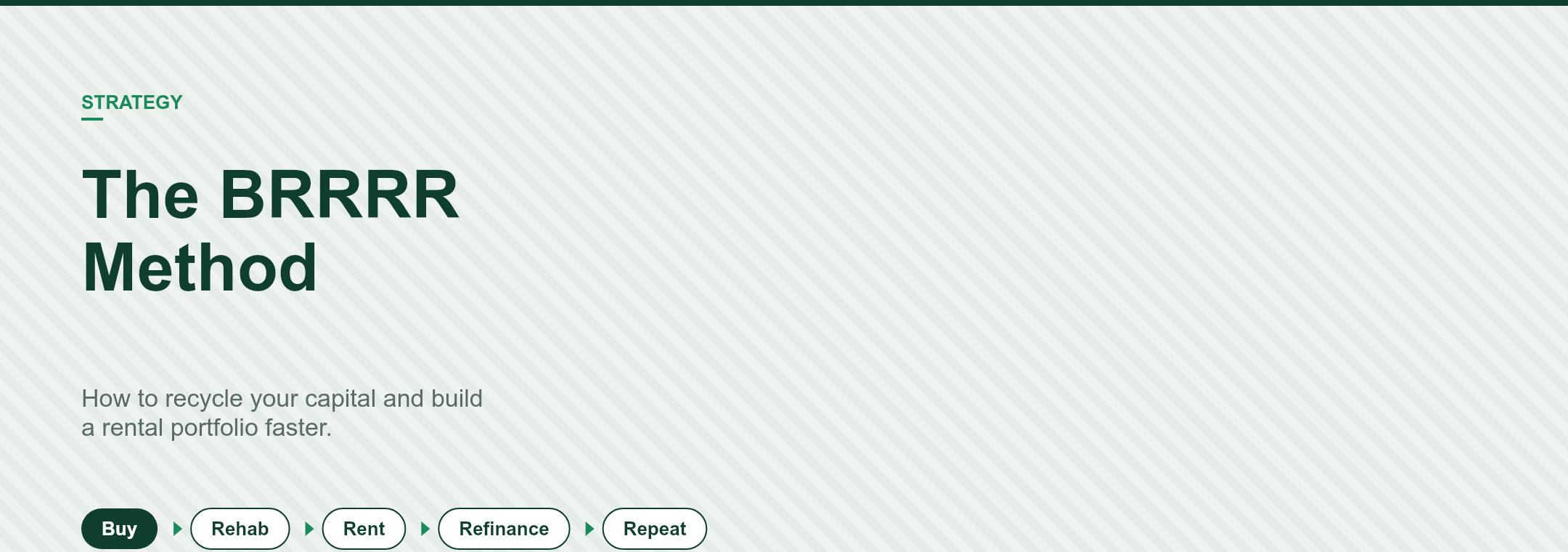
The BRRRR Method Explained: How to Recycle Your Capital and Build a Rental Portfolio Faster
Most investors assume building a rental portfolio means saving up a new down payment for every property they buy. The BRRRR method breaks that assumption.
Done right, you can pull most—or all—of your original investment back out of a property, deploy that capital into the next deal, and do it again. Instead of your money sitting locked in equity, it keeps working.
This guide explains exactly how the BRRRR method works, what the numbers need to look like, and where investors go wrong.
What Does BRRRR Stand For?
Buy. Rehab. Rent. Refinance. Repeat.
Each letter is a stage in the strategy:
- Buy a distressed or undervalued property below market value
- Rehab it to increase its value and make it rent-ready
- Rent it to a qualified tenant to establish income
- Refinance with a cash-out loan based on the new appraised value
- Repeat the process with the capital you pulled out
The strategy works because you're creating value through the rehab—buying at one price, improving the property, then borrowing against a higher appraised value after the work is done.
Why Investors Use the BRRRR Method
Traditional buy-and-hold investing has one major constraint: every new property requires a new down payment. Your portfolio grows only as fast as you can save.
BRRRR changes that math.
Instead of leaving your capital permanently tied up in a single property, a successful BRRRR lets you recover most of it through the refinance. That freed-up capital funds the next deal—without waiting years to save again.
Investors who execute BRRRR consistently can scale a rental portfolio significantly faster than those using conventional purchasing alone.
How the Numbers Work
The strategy only works if the after-repair value (ARV) is high enough to support a cash-out refinance that returns your invested capital.
Here's a simplified example:
The Purchase
- Purchase price: $90,000
- Rehab budget: $30,000
- Closing costs + carrying costs: $5,000
- Total cash invested: $125,000
After Rehab
- After-repair value (ARV): $175,000
- Lender offers cash-out refinance at 75% LTV
- New loan amount: $131,250
The Result
- Loan pays back your $125,000 investment
- You have $6,250 left over
- The property cash-flows as a rental
- You have your capital back to deploy again
In this scenario, you effectively acquired a cash-flowing rental property with little to none of your own money permanently tied up.
The Key Formula: Maximum Allowable Offer
Before you make an offer on any BRRRR candidate, you need to know the most you can pay and still make the numbers work.
Maximum Allowable Offer (MAO) = (ARV × Target LTV) − Rehab Costs − Closing/Carrying Costs − Desired Cash Left In
If your target is to recover 100% of your capital:
MAO = (ARV × 0.75) − Rehab − All Other Costs
If the seller won't accept that price, pass. Paying too much is where most BRRRR deals fail.
What Can Go Wrong
The BRRRR method has more moving parts than a standard purchase. Each stage introduces risk.
1. Rehab goes over budget.
The most common BRRRR killer. A $30,000 rehab that becomes $45,000 can wipe out the equity you were counting on. Get detailed contractor bids—not estimates—before you close.
2. The appraisal comes in low.
ARV is an estimate until an appraiser puts a number on it. If the appraisal comes in below projections, your refinance loan is smaller and you leave more capital in the deal than planned.
3. You can't find a qualified tenant quickly.
Lenders typically require a signed lease and often 6+ months of rental history before they'll do a cash-out refinance. Extended vacancy delays your refinance and adds holding costs.
4. Refinance terms are unfavorable.
If rates have risen significantly since you bought, your refinanced mortgage may create negative or very thin cash flow. Model the post-refinance cash flow—not just the equity math—before committing.
5. You underestimate carrying costs.
Property taxes, insurance, utilities, and loan interest during the rehab period add up quickly. A 4-month rehab on a $90,000 property can easily cost $3,000–$5,000 in holding costs alone.
BRRRR vs. Traditional Buy-and-Hold
| Factor | Traditional Buy-and-Hold | BRRRR |
|---|---|---|
| Capital required per property | Full down payment | Down payment + rehab, mostly recovered |
| Rehab required | No | Yes |
| Portfolio growth speed | Slower | Faster if executed well |
| Complexity | Low | High |
| Risk of loss | Lower | Higher if ARV or rehab estimates are off |
| Best market | Move-in ready, stable prices | Distressed inventory, rising or stable values |
BRRRR is not better than traditional buy-and-hold in every situation. It's a tool for investors who want to scale faster and are willing to manage the additional complexity and risk.
When BRRRR Makes Sense—and When It Doesn't
BRRRR makes sense when:
- You can consistently find properties 20–30% below ARV
- You have reliable contractors who deliver on budget and on time
- Your local market supports the ARV you need
- You have experience managing rehabs or a strong team to do it
BRRRR probably doesn't make sense when:
- You're buying in a hot market where distressed inventory is scarce
- You don't have strong contractor relationships yet
- Interest rates make post-refinance cash flow marginal
- This is your first investment property
Tracking a BRRRR Deal Accurately
Each stage of a BRRRR deal generates costs that must be tracked separately to know whether the strategy worked.
The rehab phase alone typically involves dozens of expense entries: materials, labor, permits, inspections, staging. Losing track of even a few thousand dollars means your post-refinance numbers are wrong—and you won't know it until it's too late.
ProfitTrackr is built to track the full BRRRR lifecycle. You can log every rehab expense as it happens, model the refinance math before you commit, and see your projected cash-on-cash return on the post-refi rental in real time.
When you're deciding whether to proceed to refinance, the answer should come from accurate numbers—not optimistic estimates.
Key Takeaways
- The BRRRR method lets you recycle capital by pulling equity out through a cash-out refinance after stabilizing a rental.
- The strategy only works if you buy at a price that supports a 75% LTV refinance after the rehab adds value.
- Rehab overruns and low appraisals are the most common reasons BRRRR deals fail.
- Model the post-refinance cash flow, not just the equity math, before committing.
- Accurate expense tracking during the rehab phase is essential—cost creep you don't catch early destroys the deal.
ProfitTrackr helps real estate investors analyze deals, track rehab expenses, and model BRRRR returns before and after refinance. Start analyzing your properties free →