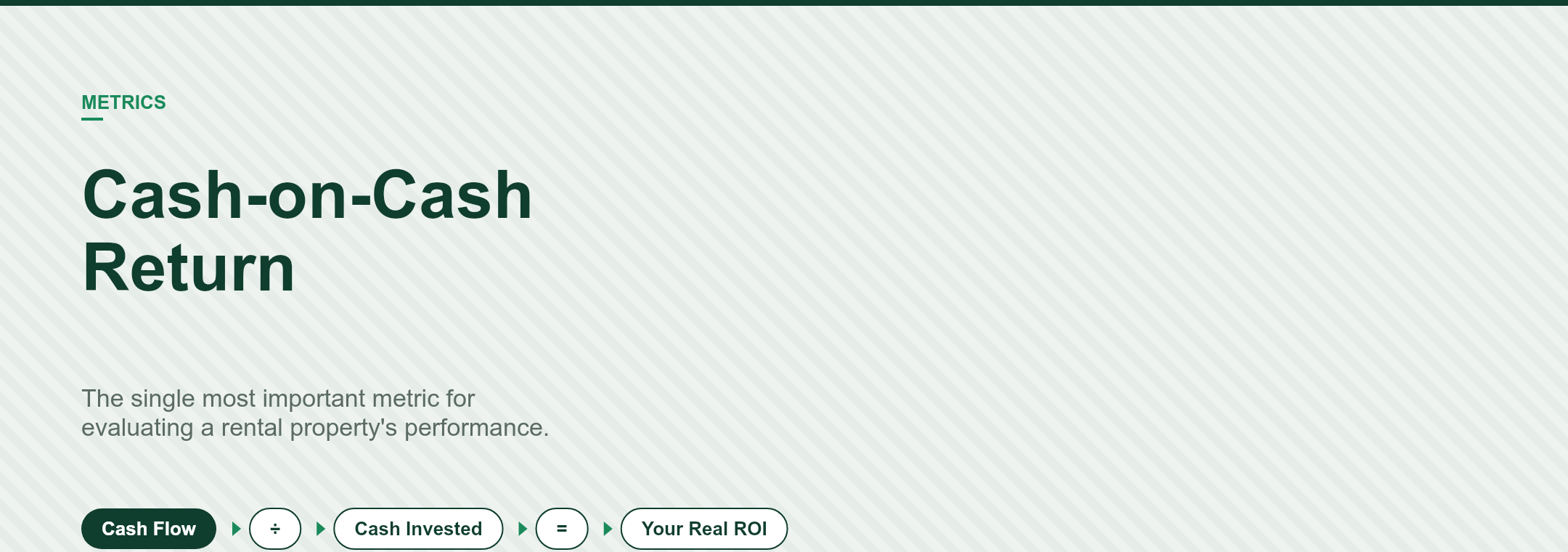
Cash-on-Cash Return: The One Number Every Rental Investor Must Know
If you own or are considering buying a rental property, one metric tells you more than almost any other: cash-on-cash return.
It's not complicated. But most investors either don't calculate it, calculate it wrong, or don't know what the result actually means for their business.
This guide covers what cash-on-cash return is, how to calculate it correctly, what a good number looks like, and how to use it to make better buying decisions.
What Is Cash-on-Cash Return?
Cash-on-cash return (CoC ROI) measures how much cash income your property generates relative to the actual cash you invested.
It's not about the property's total value. It's not about appreciation. It's about one question:
Of the real dollars I put in, how many real dollars am I getting back each year?
This makes it the most honest measure of rental property performance—because it only counts money you can actually spend.
Why It Matters More Than Other Metrics
Investors often fixate on cap rate. Cap rate is useful, but it ignores financing—which means it ignores reality for most buyers.
Cash-on-cash return reflects how you financed the deal. Two investors can buy the same property at the same price and get completely different cash-on-cash returns based on how much they put down and what rate they got.
That's why cash-on-cash return is the metric you should use to evaluate whether your deal makes sense for your portfolio.
How to Calculate Cash-on-Cash Return
The formula is simple:
Cash-on-Cash Return = Annual Net Cash Flow ÷ Total Cash Invested
Step 1: Calculate Annual Net Cash Flow
Start with your annual gross rental income, then subtract all operating expenses and your mortgage payments.
Annual Gross Rent
Minus vacancy allowance (typically 5–8%)
Minus property management (8–12% of rent if managed)
Minus property taxes
Minus insurance
Minus maintenance and repairs (budget 1–2% of property value per year)
Minus HOA fees (if applicable)
Minus mortgage payments (principal + interest)
= Annual Net Cash Flow
Step 2: Add Up Your Total Cash Invested
This is every dollar you put into the deal out of pocket:
- Down payment
- Closing costs
- Rehab or repair costs before renting
- Any carrying costs before the property was rented
Step 3: Divide
Annual Net Cash Flow ÷ Total Cash Invested = Cash-on-Cash Return
A Real Example
You buy a rental property for $200,000.
- Down payment (20%): $40,000
- Closing costs: $4,000
- Light rehab before renting: $6,000
- Total cash invested: $50,000
Monthly rent: $1,600
Annual gross rent: $19,200
Vacancy (6%): −$1,152
Property management (10%): −$1,920
Taxes + insurance: −$3,000
Maintenance reserve: −$2,000
Mortgage (P+I on $160k at 7%): −$12,763
Annual net cash flow: −$1,635
In this example, your cash-on-cash return is negative. That deal loses money.
Change the numbers—buy at $180,000, put 25% down, find a tenant at $1,800/month—and the same property type could produce a 6–8% cash-on-cash return.
This is why running the numbers before you close matters so much.
What Is a Good Cash-on-Cash Return?
There's no universal answer, but here are general benchmarks most experienced investors use:
| Cash-on-Cash Return | What It Usually Means |
|---|---|
| Below 0% | Losing money on cash flow |
| 1–4% | Marginally cash-flowing; depends on appreciation thesis |
| 5–8% | Solid cash-flowing rental in most markets |
| 8–12% | Strong return; often found in lower-cost markets |
| 12%+ | Exceptional; verify your numbers carefully |
Your personal target should depend on your goals, market, and alternative investments. Many experienced buy-and-hold investors target 6–8% as a minimum.
Common Mistakes That Inflate Your Calculation
1. Forgetting vacancy.
Assuming 100% occupancy is the single biggest mistake new investors make. Plan for 5–8% vacancy regardless of current market conditions.
2. Underestimating maintenance.
"It's a newer property" is not a maintenance budget. Set aside 1–2% of the property value per year. HVAC, water heaters, roofs, and appliances don't care how optimistic you are.
3. Using optimistic rent estimates.
Use actual comparable rents from current listings in the neighborhood—not what you hope to charge.
4. Leaving out all your closing costs and rehab.
Every dollar you spent getting the property rent-ready should be in your cash invested number.
5. Ignoring property management costs even if you self-manage.
Self-managing saves money today but has a cost. If you ever sell or step back, that expense becomes real. Model it anyway.
How Cash-on-Cash Return Connects to Your Investment Strategy
Cash-on-cash return is the primary metric for buy-and-hold investors and BRRRR investors evaluating a refinanced rental's ongoing performance.
For flippers, the relevant metric is flip ROI—how much profit you made relative to cash deployed on that one project.
For STR (short-term rental) investors, cash-on-cash return still applies, but your gross income estimate needs to reflect occupancy rates and platform fees more carefully than a long-term rental.
Know which strategy you're running before you evaluate any deal.
How ProfitTrackr Automates This Calculation
Running these numbers manually in a spreadsheet is error-prone and time-consuming—especially when you're evaluating multiple properties at once.
ProfitTrackr calculates cash-on-cash return automatically for every property in your portfolio. Enter the purchase price, financing terms, expected rent, and expenses, and you get an instant Investment Score alongside your projected CoC ROI, monthly cash flow, and equity position.
When you're comparing three prospects at the same time, seeing these numbers side by side makes the right decision obvious.
The goal isn't just to track numbers. It's to help you decide whether to buy, hold, or pass—before you commit your capital.
Key Takeaways
- Cash-on-cash return measures annual net cash flow divided by total cash invested.
- It accounts for your specific financing, which makes it more useful than cap rate for individual investors.
- Most experienced investors target 6–8% or higher as a minimum.
- The biggest calculation mistakes come from underestimating vacancy, maintenance, and total cash required to close.
- Run the numbers on every deal before you make an offer—not after.
ProfitTrackr helps real estate investors analyze deals, track expenses, and measure portfolio performance in one place. Start analyzing your properties free →