Most new investors ask the wrong question when evaluating a rental property.
They ask: "What's the cap rate?" or "What's the appreciation potential?" Both matter. But neither tells you what you actually need to know before you write a check: How much cash will this property put back in my pocket relative to what I put in?
That's what cash-on-cash return tells you. And once you understand it, it becomes the first number you look at on every deal.
What Is Cash-on-Cash Return?
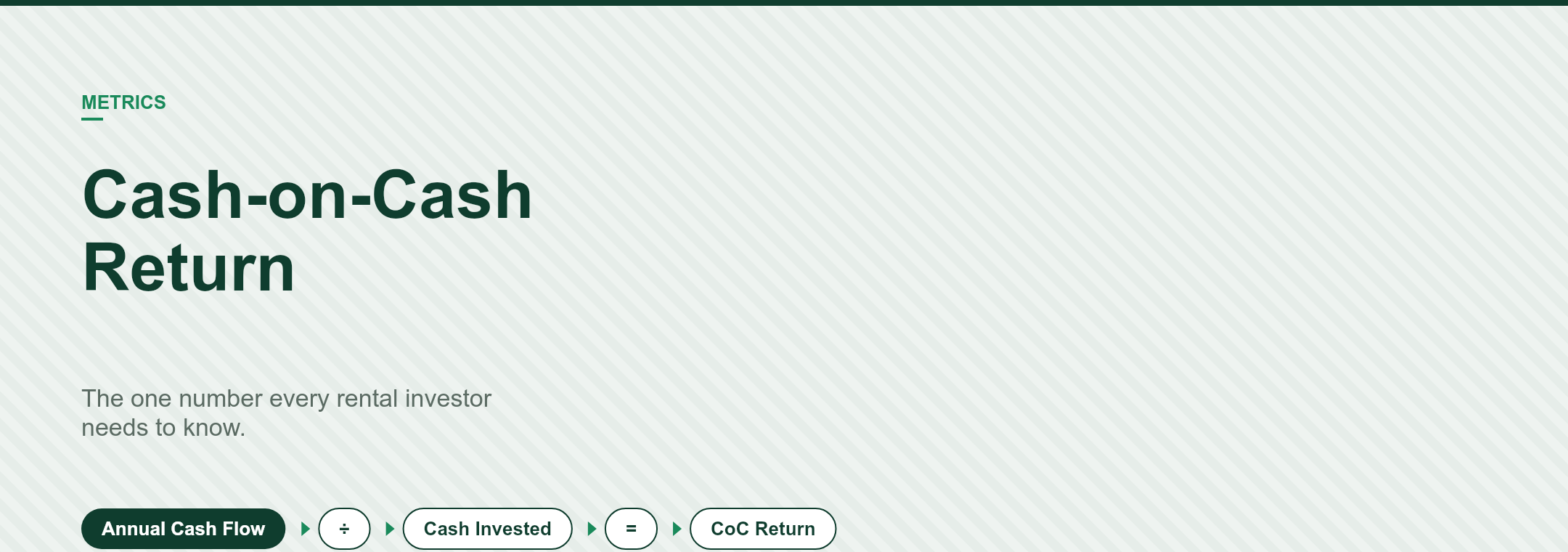
Cash-on-cash return (CoC ROI) measures the annual pre-tax cash flow a property generates as a percentage of the total cash you invested.
The formula:
Annual Cash Flow ÷ Total Cash Invested = Cash-on-Cash Return
It's that simple — and that powerful.
Unlike cap rate, cash-on-cash accounts for your financing. Unlike appreciation projections, it's based on real numbers you can calculate today. It answers the only question that matters when you're deciding whether to invest: "What do I actually earn on the money I'm putting in?"
A Simple Example
Say you buy a rental property and here's your situation:
- Purchase price: $150,000
- Down payment (20%): $30,000
- Closing costs: $3,500
- Rehab / move-in repairs: $4,500
- Total cash invested: $38,000
After all expenses — mortgage, taxes, insurance, property management, maintenance reserves — your property nets $320/month in cash flow, or $3,840/year.
$3,840 ÷ $38,000 = 10.1% cash-on-cash return
That means for every dollar you put into this deal, you earn roughly 10 cents per year in cash. Compare that to a savings account, a stock index, or your next best use of $38,000 — and you'll know quickly whether it's worth doing.
What's a Good Cash-on-Cash Return?
This depends on your market, your strategy, and your alternatives — but here are general benchmarks most experienced investors use:
| CoC Return | What It Signals |
|---|---|
| Below 5% | Likely a speculative play; you're betting on appreciation |
| 6–8% | Acceptable in expensive or high-appreciation markets |
| 8–12% | Strong return; solid cash-flowing rental |
| 12%+ | Excellent; often found in secondary markets or value-add deals |
There's no universal "good" number. A 6% CoC in a hot coastal market where rents are rising 8% per year may outperform a 12% CoC in a stagnant Midwest city. Context matters.
That said, if you're buying purely for cash flow (not appreciation), most investors target 8% or higher.
What Goes Into the Calculation
Getting cash-on-cash right requires accurate numbers in two buckets:
Total Cash Invested
This is every dollar you put out of pocket to acquire and control the property:
- Down payment
- Closing costs (title, attorney, lender fees, etc.)
- Inspection and due diligence costs
- Immediate repairs before renting
- Any reserves required by your lender at closing
Common mistake: Investors forget closing costs or initial repairs and their CoC looks better than it is. Always use the full cash-out number.
Annual Cash Flow
This is gross rental income minus every expense:
- Mortgage payment (principal + interest)
- Property taxes
- Insurance
- Property management fees (typically 8–12% of rent)
- Maintenance and repairs reserve (typically 5–10% of rent)
- Vacancy allowance (typically 5–8%)
- HOA fees (if applicable)
- Utilities paid by landlord
Common mistake: Investors exclude vacancy, maintenance reserves, and management fees. That makes the property look like a cash machine on paper and a money pit in reality.
Cash-on-Cash vs. Cap Rate: What's the Difference?
You'll hear both terms constantly. Here's the distinction:
Cap rate ignores financing. It measures a property's income-producing potential as if you paid all cash. It's useful for comparing properties independent of how they're financed — or for institutional investors who buy with cash.
Cash-on-cash return reflects your actual return based on your financing. Two investors can buy the same property and get completely different CoC returns depending on their down payment, interest rate, and loan terms.
For most individual investors, cash-on-cash is the more actionable number. It's what you actually earn.
Why Your Financing Terms Change Everything
Run these two scenarios on the same $200,000 property generating $1,400/month gross rent:
Scenario A: 20% down, 7.5% rate
- Cash invested: ~$47,000
- Monthly cash flow: ~$210
- CoC return: ~5.4%
Scenario B: 25% down, 6.5% rate
- Cash invested: ~$57,000
- Monthly cash flow: ~$380
- CoC return: ~8.0%
Same property. Different financing. Completely different outcome.
This is why experienced investors obsess over their interest rate and loan terms — not just the purchase price.
Improving Your Cash-on-Cash Return
If a property doesn't hit your target CoC, you have a few levers:
1. Negotiate a lower purchase price.
Less cash out, same income = better return.
2. Reduce your down payment (while managing your cash flow risk).
Less cash invested improves CoC — but watch your monthly payment.
3. Increase rents.
If the property is under-rented, buying it gives you an immediate value-add opportunity.
4. Reduce expenses.
Self-managing instead of hiring a property manager, or buying in a lower-tax area, can meaningfully improve cash flow.
5. Add income streams.
Laundry, storage, parking — ancillary income improves CoC without changing your purchase cost.
The Mistake That Kills Cash-on-Cash Projections
The single most common error: using optimistic numbers instead of conservative ones.
Investors underestimate:
- Vacancy (budgeting 1–2% when reality is 5–8%)
- Maintenance (ignoring reserves until the HVAC dies)
- Management fees (planning to self-manage forever)
- Tax increases (especially in fast-growing markets)
Run your CoC with conservative inputs. If it still works, you have a deal. If it only works with perfect assumptions, walk away — real estate never delivers perfect assumptions.
How ProfitTrackr Calculates Cash-on-Cash Return
ProfitTrackr computes cash-on-cash return automatically as you enter a property's details. Every input — purchase price, financing terms, rent, expense assumptions — feeds directly into the calculation.
When you adjust a number, your CoC updates immediately. This lets you run scenarios in real time: What happens to my return if I put 25% down instead of 20%? What if rent drops 10%?
You'll also see cash-on-cash return tracked for owned properties as actual income and expenses are recorded — so your projected CoC and your real CoC are always visible side by side. That gap tells you whether your underwriting was accurate, and what to adjust on the next deal.
Understanding where you were wrong is how you get better. That feedback loop is one of the most valuable habits a growing investor can build.
Bottom Line
Cash-on-cash return is the clearest, most honest measure of what a rental property actually earns relative to what you put in.
Calculate it on every deal before you make an offer. Use conservative numbers. Know your minimum threshold before you start shopping, so you're not talking yourself into bad deals because you fell in love with a house.
The investors who build lasting portfolios aren't the ones who find the most properties. They're the ones who know their numbers well enough to say no to the wrong ones — and yes to the right ones faster.
ProfitTrackr calculates cash-on-cash return automatically for every property you analyze. Start tracking your deals for free →