Most investors think portfolio growth is a math problem: more properties require more cash. And for a while, that's true.
But the investors who build the fastest portfolios figured out how to get their capital back after each deal — and deploy it again on the next one. That's the BRRRR strategy.
It doesn't eliminate the need for capital. But when executed well, it dramatically reduces how much you leave behind in each property, letting you acquire more deals than a traditional buy-and-hold approach allows.
What Does BRRRR Stand For?
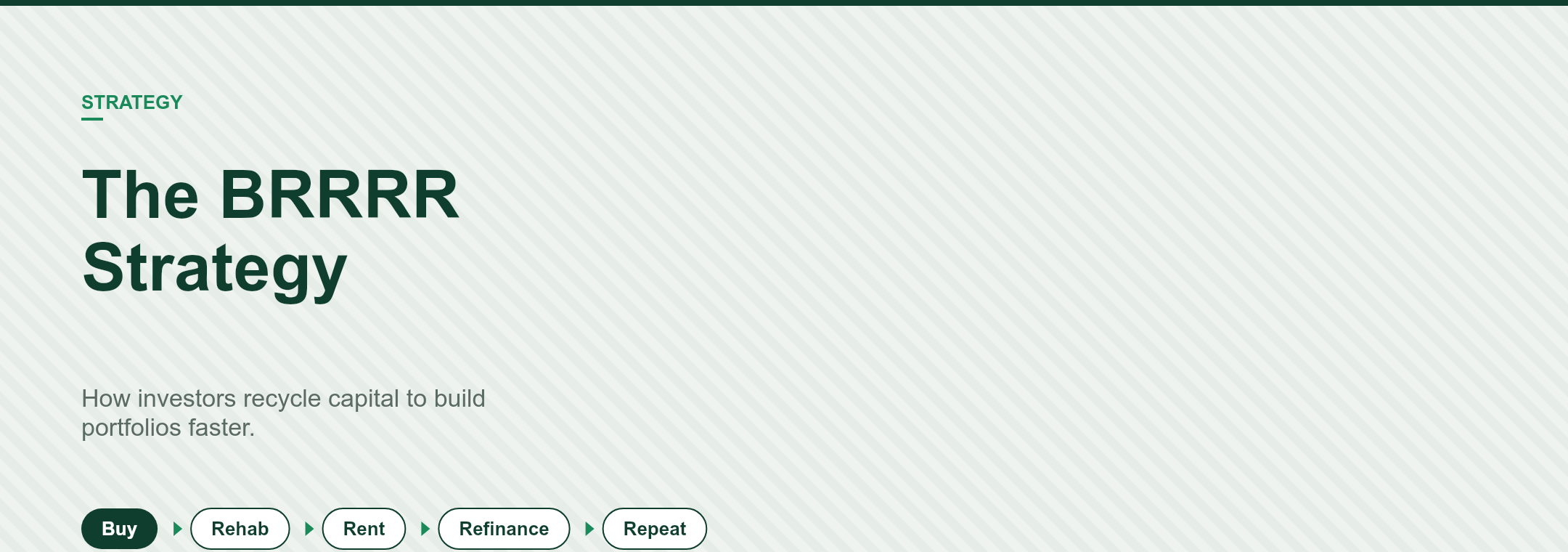
BRRRR is an acronym for the five steps of the strategy:
- Buy — acquire a distressed or undervalued property below market value
- Rehab — renovate it to increase value and attract quality tenants
- Rent — stabilize the property with a tenant and proven cash flow
- Refinance — do a cash-out refinance based on the new, higher appraised value
- Repeat — use the cash you pulled out to fund the next deal
The key insight: by buying below market and adding value through renovation, you can often refinance out most — or all — of what you originally invested. Your original capital becomes available for the next property while the tenant's rent covers the new mortgage.
A Real Example
Here's a straightforward BRRRR scenario:
Purchase phase:
- Distressed property purchase price: $80,000
- Renovation cost: $25,000
- Closing costs and carrying costs: $5,000
- Total cash invested: $110,000
After renovation:
- New appraised value (ARV): $160,000
- Cash-out refinance at 75% LTV: $120,000
Result:
- You receive $120,000 from the refinance
- You pay off your original purchase financing (~$80,000 loan)
- Cash returned to you: ~$40,000
- Cash left in the deal: ~$70,000 (your renovation + costs, minus cash returned)
In an ideal BRRRR, your refinance proceeds cover your total investment — meaning you've recycled most or all of your capital. In practice, you'll usually leave some money in the deal. That's fine, as long as the property still cash flows and the amount left behind is acceptable given your goals.
Why ARV Is the Engine of the Whole Strategy
After Repair Value (ARV) is the estimated market value of the property after renovations are complete. It determines how much the bank will lend you on the refinance — and therefore how much capital you can pull back out.
If your ARV estimate is wrong, the whole strategy breaks.
Investors get into trouble when they:
- Overestimate ARV based on wishful thinking rather than comparable sales
- Budget renovation costs incorrectly, eating into their equity cushion
- Underestimate the time between purchase and refinance (which adds carrying costs)
Before you buy, you need a solid ARV estimate. Pull recent sales of comparable properties within a half-mile radius. Be conservative — appraisers don't give you credit for cosmetic improvements the way you think they will.
The Refinance: What Lenders Actually Look For
Most BRRRR investors use a conventional cash-out refinance after the property is renovated and rented. Here's what lenders typically require:
- Seasoning period: Many lenders require you to own the property for 6–12 months before they'll do a cash-out refinance. This is crucial — plan your timeline around it.
- LTV limits: Most lenders cap cash-out refis at 70–75% of appraised value for investment properties.
- Debt-to-income (DTI): Your personal DTI, including the new loan payment, must meet underwriting requirements.
- Stable rental income: Lenders typically want to see a signed lease and at least some rental history.
Portfolio lenders and local community banks often have more flexibility than big national banks. If you're doing multiple BRRRRs, building a relationship with a local lender who understands your strategy is worth the effort.
When BRRRR Works Best
The strategy works best when all three conditions are present:
1. You can buy significantly below ARV.
If you're paying market price for a turnkey property, there's no equity to extract. BRRRR requires buying distressed properties — foreclosures, estate sales, off-market deals, properties that need more work than most buyers want to take on.
2. You can control renovation costs.
Your rehab budget is what creates the equity spread between your total investment and your ARV. Cost overruns destroy your return. You need reliable contractors and detailed scopes of work — not ballpark estimates.
3. The property cash flows after the refinance.
After you refinance, your mortgage payment goes up (you've borrowed more money). The property still needs to generate positive cash flow with that higher payment. Run the numbers with the post-refinance payment before you ever make an offer.
Common BRRRR Mistakes
Miscalculating ARV.
This is the single biggest mistake. Investors confuse what they want the property to be worth with what comps actually support. Always ground your ARV in closed sales data, not active listings.
Underbudgeting the rehab.
Every renovation has surprises. Budget 10–15% more than your contractor's estimate. If you don't need it, great — that's extra equity. If you do, you're not scrambling.
Ignoring the seasoning requirement.
Some investors tie up a significant portion of their liquid capital in a deal, planning to pull it back out in 90 days — only to discover their lender requires 12 months. Know your refinance timeline before you close.
Forgetting carrying costs.
Every month between purchase and tenant move-in costs money: taxes, insurance, utilities, loan payments (if using hard money or a bridge loan). These are real costs that reduce your equity. Build them into your projections.
Not stress-testing cash flow post-refi.
The goal isn't just to recover your cash. It's to end up owning a property that cash flows well after the refinance. If the higher loan payment wipes out your monthly profit, you've traded cash flow for capital recycling — and that's not always a good trade.
BRRRR vs. Traditional Buy-and-Hold
| | Traditional Buy and Hold | BRRRR |
|---|---|---|
| Capital required per deal | Full down payment + closing | Same upfront, but often recovered |
| Risk level | Lower (turnkey, no rehab) | Higher (rehab execution risk) |
| Equity at close | Market equity | Created equity (value-add) |
| Time to next deal | After saving another down payment | After refinance seasoning |
| Returns | Depends on purchase price | Amplified if ARV spread is strong |
Neither is universally better. BRRRR accelerates portfolio growth but requires more skill, more active management during rehab, and more precise underwriting. Traditional buy-and-hold is simpler and better suited for passive investors.
Many experienced investors do both: BRRRR on the right deals, straight purchases on others.
How ProfitTrackr Supports the BRRRR Strategy
When you add a property in ProfitTrackr and tag it as a BRRRR, the platform automatically calculates the metrics that matter most for this strategy:
- Equity position — current value minus estimated loan balance, so you can see whether you're on track to refinance at your target LTV
- Cash-on-cash return post-refi — what you'll actually earn after the new mortgage payment
- Rehab budget tracking — actual spend vs. projected, updated as you record expenses
As you record renovation expenses, your projected equity position updates in real time. That means you know immediately if cost overruns are threatening your refinance math — before you've spent money you can't recover.
You'll also see your BRRRR properties separately from other holdings, so you can track which deals are in the buy/rehab phase vs. stabilized and generating income.
Is BRRRR Right for You?
BRRRR is not a beginner strategy in the sense that it requires real execution skill — finding distressed properties, managing a renovation, and accurately predicting ARV. But it's also not reserved for full-time investors. Many part-time investors have used it to build solid portfolios one deal at a time.
Ask yourself:
- Can you find properties priced significantly below their post-renovation value?
- Do you have access to reliable contractors?
- Do you have the capital to carry the deal through the renovation and seasoning period?
- Do you have the patience to wait 6–12 months between purchase and refinance?
If the answer to all four is yes, BRRRR may be the most capital-efficient path to building the portfolio you want.
Run the numbers before you fall in love with a property. ARV first. Rehab budget second. Post-refi cash flow third. If all three work, you might have a deal worth pursuing.
ProfitTrackr tracks your BRRRR deals end-to-end — from purchase through refinance — so you always know exactly where you stand. Start analyzing deals for free →