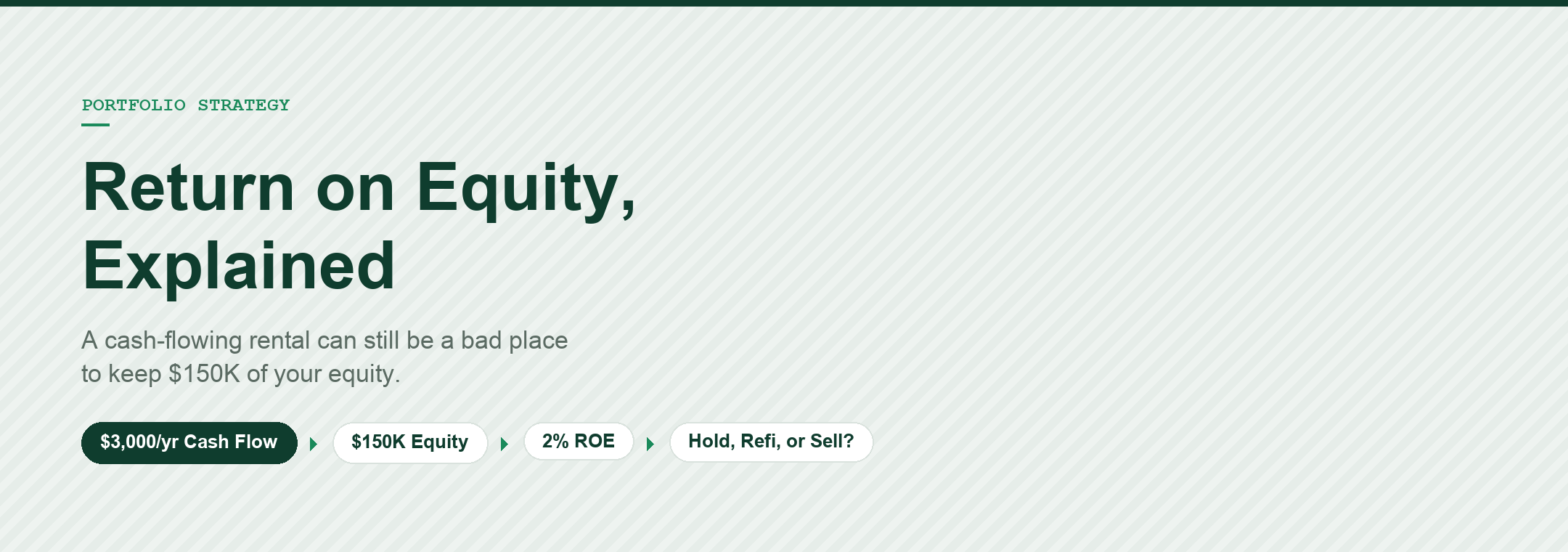
A property you bought five years ago for $180,000 with $40,000 down might be worth $280,000 today with a $130,000 loan balance. That's $150,000 in equity sitting in one house. If it's still cash flowing $250 a month, most investors call that a win and leave it alone.
But $250 a month on $150,000 of equity is a 2% annual return. You could get better than that in a savings account. The property isn't a bad asset — it's just holding a huge amount of your capital hostage at a return that no longer makes sense. That's what return on equity measures, and it's the number that tells you when a "good" rental has quietly become a mediocre place to keep your money.
Why It Matters
Cash-on-cash return tells you how a property is performing against what you originally invested. It never updates as the property appreciates and the loan gets paid down. Return on equity tells you how the property is performing against what you actually have tied up in it right now — and that number almost always gets worse over time, even while cash flow stays flat or improves.
This is the metric that surfaces a specific, common trap: a rental that looked great on day one but has become an inefficient place to park capital because equity built up faster than income did. Without checking ROE periodically, that capital just sits there, quietly earning less than it could elsewhere in your portfolio, or outside it entirely.
How to Calculate Return on Equity
Return on Equity = Annual Cash Flow ÷ Current Equity
Current equity is today's estimated value minus today's loan balance — not what you paid, and not what you originally put down.
Example:
- Purchase price: $180,000, with $40,000 down
- Current estimated value: $280,000
- Current loan balance: $130,000
- Current equity: $280,000 − $130,000 = $150,000
- Annual cash flow: $3,000
Return on equity: $3,000 ÷ $150,000 = 2%
Compare that to the day-one cash-on-cash return: $3,000 ÷ $40,000 = 7.5%. Same property, same cash flow, wildly different story depending on which number you're looking at. The 7.5% figure describes a decision you already made. The 2% figure describes the decision in front of you right now.
Why ROE Drops Even When Everything Is Going Right
This is the part that catches investors off guard: return on equity falls precisely because the investment is succeeding.
- Appreciation increases the property's value, which increases equity, without increasing cash flow at all.
- Principal paydown reduces the loan balance every month, which also increases equity, again with no effect on cash flow.
- Rent increases do grow cash flow over time, but usually far slower than equity grows in a strong market.
A property can be executing exactly as planned — appreciating, getting paid down, generating steady rent — and still see its return on equity cut in half over five or six years. That's not a sign something went wrong. It's a sign the property has moved from "efficient use of capital" to "warehouse for equity," and it's worth checking whether that capital would work harder somewhere else.
What to Do When ROE Gets Low
A low return on equity isn't an automatic sell signal. It's a prompt to compare three options:
Hold. Fine if you're prioritizing appreciation, principal paydown, tax benefits, or long-term equity building over current yield — and you don't have a better place to put the capital right now.
Refinance. A cash-out refinance lets you pull equity out and redeploy it into a new acquisition, while keeping the original property and its appreciation potential. This resets your equity in the property lower and, if underwritten right, raises your ROE on the capital you keep in it while putting the extracted cash to work elsewhere.
Sell. If a 1031 exchange or straight sale would let you redeploy that $150,000 into a property (or two) generating a meaningfully higher return, the current rental's job may be done. This is the calculation that turns "I'll never sell a good rental" into "I sold a good rental to buy two better ones."
There's no universal threshold — some investors act at 4% ROE, others are comfortable holding at 2% for the appreciation and tax benefits. What matters is running the number on purpose instead of never checking it.
Common Mistakes
Only ever looking at cash-on-cash return. It's the right metric for evaluating a deal before you buy it. It's the wrong metric for deciding whether to keep a property you've owned for years, because it's frozen at your original investment and ignores how much capital is actually parked there today.
Guessing at current value. Return on equity is only as good as your equity estimate. Using a stale purchase price instead of a current market value estimate will always understate how much capital is tied up and overstate the return.
Never revisiting properties you assume are "done." The properties most likely to have a badly degraded ROE are the ones you bought earliest and haven't looked at critically in years — precisely because they've had the most time to appreciate and pay down.
Treating every low-ROE property the same. A property with strong appreciation potential in a supply-constrained market may be worth holding at 2% ROE. A property in a slow-growth area with the same 2% ROE may just be trapped capital.
How ProfitTrackr Helps
ProfitTrackr calculates return on equity automatically for every owned property, using your current estimated value and current loan balance rather than your original purchase numbers — so you're never manually re-deriving it or relying on a spreadsheet that quietly went stale.
Because it's visible alongside cash-on-cash return and monthly cash flow on the same property, you can see both stories at once: how the deal has performed since you bought it, and how it's performing on the capital sitting in it today. That makes it easy to scan an entire portfolio and spot which properties have become inefficient places to store equity — the ones worth a serious look at refinancing or selling — instead of relying on a gut feeling that a property "still seems fine."
Key Takeaways
- Return on equity = annual cash flow ÷ current equity (today's value minus today's loan balance), not your original cash invested
- ROE drops over time even when a property performs well, because appreciation and principal paydown grow equity faster than cash flow grows
- A low ROE isn't a sell signal by itself — it's a prompt to compare holding, refinancing, and selling
- Cash-on-cash return answers "was this a good deal." Return on equity answers "is this still a good use of my capital right now."
- Review ROE portfolio-wide periodically, especially on your oldest properties — they've had the most time for the gap to open up
Related articles: Cap Rate vs. Cash-on-Cash Return: Which Metric Actually Matters | The BRRRR Strategy Explained